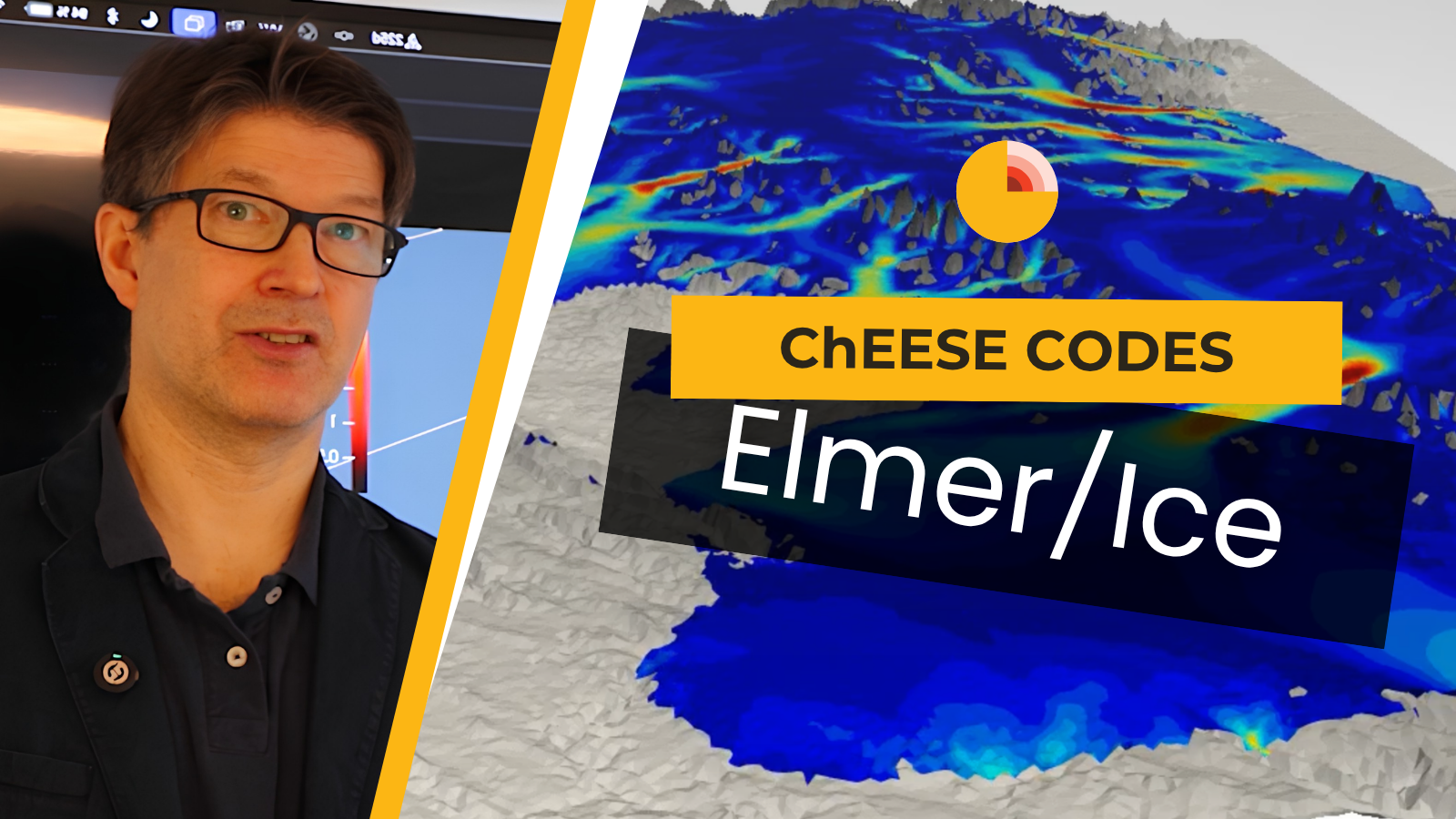
Built on the open-source multiphysics code Elmer, Elmer/Ice enables scientists to simulate the interaction between glacier movement and subglacial water flow, one of the most challenging processes in glaciology. Within ChEESE, researchers have advanced the code by coupling these complex physical models, bringing them closer to realistic simulations of glacial lake outburst floods.
The long-term goal is to provide authorities with more accurate risk assessments and, ultimately, hazard maps that support faster and better-informed decisions. Beyond glacier hazards, Elmer has already been applied to a wide range of real-world problems, from semiconductor manufacturing to ice-sheet modelling used in the Intergovernmental Panel on Climate Change (IPCC) climate assessments.
Known in Iceland as jökulhlaups, these glacial lake outburst floods pose severe threats to downstream communities, livestock, bridges, and energy networks. Predicting when and how an outburst will occur remains one of the trickiest puzzles in geophysics.
Through the second phase of the ChEESE Centre of Excellence, researchers are harnessing supercomputers to demystify these hidden processes. At the heart of this work is Elmer/Ice, an open-source simulation package designed to model the physics of large ice masses under extreme stress.
In a recent interview, Thomas Zwinger, Senior Application Scientist at CSC (the Finnish Supercomputing Center) and code lead within ChEESE, explains how computational glaciology is moving from purely descriptive science toward life-saving hazard assessment.
Pressure, Ice, and Gravity
In places like Iceland, underground volcanic heat and melting surface ice feed huge pockets of water trapped beneath massive glaciers such as Vatnajökull. Because these lakes sit so high in the mountains, they act like perched reservoirs, holding back millions of tons of water ready to rush downhill if given an exit.
“By definition, any loose material like water that is on a high elevation is a potential hazard risk,” Zwinger points out. “In this case, the water becomes overpressurised, lifts the whole glacier, and makes its way underneath the ice down into the valley, where it bursts out and produces very intense floods.”
The threat is far from exclusive to Iceland. Alpine regions face comparable dilemmas. Zwinger recalls an alarming case at the Tête Rousse glacier on the slopes of Mont Blanc in France, where authorities discovered a massive pocket of pressurised water trapped inside the ice. With downstream valleys historically devastated by catastrophic glacial bursts, civil protection needed to act fast.
The dilemma was fraught with risk: could they safely drill and pump out millions of litres of water without triggering the structural collapse of the glacier, which sat right along the main ascent route for mountaineers? Colleagues from the Institute of Environmental Geosciences (IGE) in Grenoble turned to the Elmer code to simulate the mechanical stability of the hollowed-out glacier during pumping operations, providing crucial scientific backing to avert a tragedy.
Capturing these events on a computer screen requires a challenging mathematical toolkit. Elmer/Ice is built on top of Elmer, a versatile, open-source finite element software developed at CSC that solves coupled multiphysics problems across fluid dynamics, structural mechanics, thermodynamics, and electromagnetics.
Within Elmer, the specialised Elmer/Ice module handles the intricate, non-linear rheology of ice. Glacial ice deforms like a viscous fluid over long periods, but shatters like brittle glass when stresses spike suddenly.
Within ChEESE, researchers are studying how glaciers move and how water flows beneath them. These two processes are closely connected: as water builds up and moves under the ice, it can change the way the glacier slides and deforms. By including both processes in the same simulation, scientists can create a more realistic picture of how glacial floods begin and develop.
“HPC enables us to produce results on a relevant timescale, because in natural hazards, time is a critical factor”, Zwinger explains. “You want to have your answers before something very bad happens.”
While operational, real-time early warning systems remain a future milestone, the immediate objective within ChEESE is building high-fidelity scenario models. By simulating a matrix of possibilities, researchers can provide civil protection agencies with robust hazard maps.
“Our goal is to simulate realistic scenarios with our model and present those results to authorities, so they can take that data and turn it into actionable hazard mapping: knowing with what probability an outburst might happen, and at what timing”, Zwinger highlights.
By translating deep subglacial physics into high-resolution supercomputing simulations, the ChEESE team is working to turn unpredictable ice anomalies into measurable, manageable scenarios, helping mountain and sub-polar communities stay one step ahead of the floodwaters.
Discover the Elmer/Ice code Learn more about the code and its applications in glaciology.
Learn moreCredits
- Published
- 23 September 2026
- Author
- Aerton Guimarães & Varvara Vedia — ChEESE-2P Dissemination Team