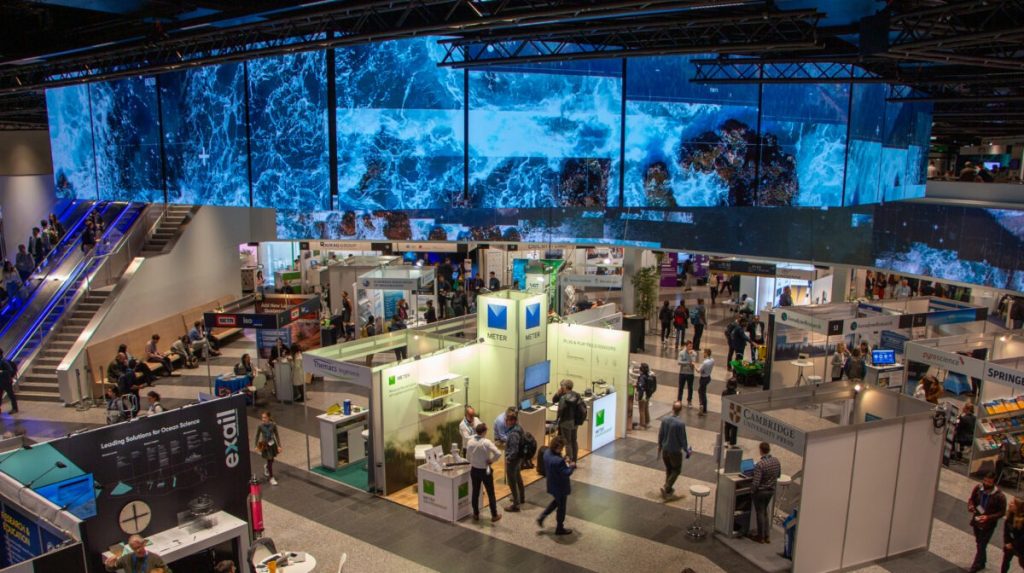
The European Geosciences Union General Assembly 2026 is one of the most important events for the ChEESE community. As expected, our researchers will be strongly represented in Vienna from 3 to 8 May, 2026.
Across oral presentations, poster sessions, and scientific sessions, ChEESE researchers will take part in a total of 30 contributions, including 12 posters and 13 oral presentations. In addition, ChEESE researchers will coordinate or co-coordinate five sessions.
This strong presence highlights the active role of the consortium in the international geoscience community and its commitment to advancing computational methods for Earth system sciences.
Find below the full programme with the participation of researchers from ChEESE partner institutions:
| When & Where | Contribution | Authors | Type & Link |
|---|---|---|---|
| Mon, 04 May08:45–08:55Room 1.14 | Assessment of the tsunamigenic potential of seamounts in the Tyrrhenian sea |
Giovanna Albano, Carlos Sánchez, Jorge Macías Sánchez, and Jacopo Selva | OralEGU26-5054 |
| Mon, 04 May09:15–09:25Room 1.14 | Propagation of the Storegga tsunami: high-resolution modelling across the North Atlantic |
Steven J. Gibbons, Stein Bondevik, Bartosz Kurjanski, Marc de la Asunción, Valentina Magni, Jorge Macías Sánchez, Andrew R. Emery, and Finn Løvholt. | OralEGU26-16703 |
| Mon, 04 May10:45–12:30Hall X5 (X5.210) | Modelling the influence of thermal state and sliding on the dynamics of Grenzgletscher, Swiss Alps |
Cristina Gerli, Elisa Mantelli, and Thomas Zwinger | PosterEGU26-878 |
| Mon, 04 May10:45–12:30Hall X5 (X5.226) | Toward modelling glacier lake outburst floods from ice-dammed lakes |
Léa Rodari, Pascal Emmanuel Egli, Samuel Cook, Thomas Zwinger, and Ann Victoria Rowan. | PosterEGU26-8068 |
| Mon, 04 May14:00–15:45Hall X4 (X4.94) | Evaluating a meteorological downscaling method for volcanic ash dispersion and deposition modelling |
Carlos Villalta López, Leonardo Mingari, Alexandros-Panagiotis Poulidis, and Arnau Folch.. | PosterEGU26-6903 |
| Mon, 04 May14:00–15:45Hall X4 (X4.96) | Simulating flood dynamics on dynamic HPC resource sets |
Daniel Caviedes-Voullième, Pablo Vallés, José Segovia-Burillo, Mario Morales-Hernández, Sergio Iserte, and Antonio Peña. | PosterEGU26-9317 |
| Mon, 04 May15:35–15:45 Room 1.14 | Nationwide Probabilistic Tsunami Hazard Assessment of Chile |
Patricio A. Catalan, Natalia Zamora, Steven Gibbons, Finn Løvholt, Manuela Volpe, Stefano Lorito, and Jorge Macias Sanchez | OralEGU26-23133 |
| Mon, 04 May16:20–16:30Room 1.14 | Towards digital-twin-enabled tsunami hazard assessment: Landslide-Tsurrogate v1.0 |
Clea Denamiel, Alexis Marboeuf, Anne Mangeney, Anne Le Friant, Marc Peruzzetto, Antoine Lucas, Manuel J. Castro Díaz, and Enrique Fernández-Nieto | OralEGU26-4898 |
| Mon, 04 May16:30–16:40Room 1.14 | A Landslide Probabilistic Tsunami Hazard Analysis for the Åkerneset and Hegguraksla rockslides (Norway) |
Valentina Magni, Sylfetst Glimsdal, Erlend Storrøsten, Finn Løvholt, and Carl Harbitz | OralEGU26-18105 |
| Mon, 04 May16:30–16:40Room 1.14 | Assessing Meteo-HySEA Performance for Adriatic Meteotsunami Events. |
Alex Gonzalez del Pino, Cléa Lumina Denamiel, and Jorge Macías Sánchez | OralEGU26-4898 |
| Tue, 05 May10:45–12:30Room 2.24 | Leveraging AI & HPC for Natural Hazard Resilience: From Enhanced Detection, Forecasting, and Modelling in Time-Critical Scenarios to Inform Climate-Adaptive Response(Orals) |
Convener: Nishtha Srivastava. Co-conveners: Marisol Monterrubio-Velasco, Jorge Macias, Yogesh Kumar Singh, Ni An, Yangzi Qiu, John Xiaogang Shi | SessionITS1.2/NH13.7 |
| Tue, 05 May10:50–11:00Room 2.24 | From physics-based simulation to ground motion models using a Machine-Learning Estimator for Ground Shaking Map |
Rut Blanco-Prieto, Natalia Zamora, Marisol Monterrubio-Velasco, and Josep de la Puente. | OralEGU26-1865 |
| Tue, 05 May11:05–11:15Room D2 | Developing a new Digital Twin for Destination Earth: Technical Progress of TerraDT in its First Year |
Narayanappa Devaraju, Jenni Kontkanen, Jenni Poutanen, Juha Tonttila, Hendryk Bockelmann, Hauke Schmidt, Nikolay Koldunov, Daniel Klocke, Etienne Tourigny, Maria Giuffrida, Harri Kokkola, Thomas Zwinger, Mario Acosta, Anton Laakso, and Sara Garavelli. | OralEGU26-1780 |
| Tue, 05 May11:20–11:30Room 2.24 | ChEESE: the European Center of Excellence for supercomputing in geosciences |
Arnau Folch | OralEGU26-5866 |
| Tue, 05 May14:00–15:45Hall X3 | Leveraging AI & HPC for Natural Hazard Resilience: From Enhanced Detection, Forecasting, and Modelling in Time-Critical Scenarios to Inform Climate-Adaptive Response (Posters)
|
Convener: Nishtha Srivastava. Co-conveners: Marisol Monterrubio-Velasco, Jorge Macias, Yogesh Kumar Singh, Ni An, Yangzi Qiu, John Xiaogang Shi | SessionITS1.2/NH13.7 |
| Tue, 05 May14:00–15:45Hall X3 (X3.146) | HPC-enabled large-scale physics-based seismic simulations as training data for AI-driven ground motion forecasting in Southern Iceland |
Marisol Monterrubio-Velasco, Natalia Zamora, Rut Blanco-Prieto, Andrea C. Riaño, Fernando Vázquez, Bibek Chapagain, and Josep de la Puente. | PosterEGU26-7756 |
| Tue, 05 May14:00–15:45Hall X3 (X3.147) | Physics-Based and AI-Driven HPC Workflows for Geophysical Hazards in GANANA project |
Natalia Zamora, Nishtha Srivastava, Carlos Sánchez, Leonardo Mingari, Arnau Folch, Jorge Macías, Marisol Monterrubio-Velasco, Georgina Diez-Ventura, Leonarda I. Esquivel-Mendiola, Fernando Vázquez-Novoa, Rosa M. Badia, and Josep de la Puente. | PosterEGU26-7839 |
| Tue, 05 May14:00–15:45Hall X3 (X3.148) | Advancing Volcanic Crisis Management through Satellite Data Assimilation in FALL3D within the ESA GET-it Digital Twin Framework |
Eva Hernandez Plaza | PosterEGU26-9859 |
| Tue, 05 May14:00–15:45Hall X3 (X3.149) | AI- and HPC–Driven Tsunami Decision Support for the Spanish TEWS: Atlantic Results and Western Mediterranean Extension |
Juan Francisco Rodríguez Gálvez, Jorge Macías Sánchez, Beatriz Gaite Castrillo, Carlos Sánchez Linares, Alejandro González del Pino, Manuel Jesús Castro Díaz, Juan Vicente Cantavella Nadal, and Luis Carlos Puertas González | PosterEGU26-10252 |
| Tue, 05 May16:15–18:00Hall X3 (X3.89) | Performance of Stochastic Tsunami Source Models Compared with Observations and Finite-Fault Inversions |
Hafize Başak Bayraktar, Stefano Lorito, Antonio Scala, Gaetano Festa, Fabrizio Romano, Alice Abbate, Manuela Volpe, Thorne Lay, Carlos Sánchez-Linares, Patricio Catalan, and Gareth Davies. | PosterEGU26-14076 |
| Tue, 05 May16:15–18:00Hall X3 (X3.97) | Towards the Global Tsunami Model Probabilistic Tsunami Hazard Analysis (GTM-PTHA) tool |
Valeria Cascone and the GTM-PTHA Working Group* | PosterEGU26-20928 |
| Tue, 05 May16:15–18:00Hall X3 (X3.96) | NEAM-COMMITMENT: Strengthening Tsunami Risk Governance through National Inundation Mapping and Multi-Hazard Evacuation Planning
|
Marinos Charalampakis, Nikos Kalligeris, Laura Graziani, Ignacio Aguirre Ayerbe, Pio Di Manna, Vitor Silva, Jorge Macias, Domenico Russo, Costas E. Synolakis, Andreas Antonakos, Sylvana Pilidou, Luigi D’Angelo, Carlos González González, and the NEAM-COMMITMENT project team* | PosterEGU26-19981 |
| Wed, 06 May09:05–09:15Room L3 | Unravelling the importance of iceberg-calving-induced hydrodynamic forces to monitor Greenland ice mass loss with seismic inversion of glacial earthquakes |
Nicolas De Pinho Dias, Alban Leroyer, Justin C Burton, Wambui Ngugi, Andreas Kjær Dideriksen, Eugenio Ruiz-Castillo, William D. Harcourt, Jeffrey Taylor Kerby, Søren Rysgaard, Olivier Castelnau, and Anne Mangeney. | OralEGU26-6643 |
| Wed, 06 May09:25–09:35Room L3 | Temporal ice-stream dynamics resulting from subtemperate sliding instabilities |
Tilly Woods, Elisa Mantelli, Thomas Zwinger, and Christian Schoof. | OralEGU26-1137 |
| Wed, 06 May11:10–11:20Room 0.96/97 | Could the complex rupture dynamics of the 2025 Mw 7.8 Myanmar Earthquake have been predicted? |
Thomas Ulrich, Xiaoyu Zou, Mathilde Marchandon, Nico Schliwa, Fengzhou Tan, Alice-Agnes Gabriel, Wenyuan Fan, Peter Shearer, Myo Thant, Tha Zin Htet Tin, Eric O. Lindsey, and Yuri Fialko | OralEGU26-14302 |
| Wed, 06 May14:00–15:45 (Posters on site & Posters Virtual) | High-performance computation with big data in the geosciences
|
Convener: Kor de Jong. Co-conveners: Juniper Tyree, Clément Bouvier, Daniel Caviedes-Voullième, Arnau Folch, Corentin Carton de Wiart. Chairperson: Andrea Barone | POSTERSESSI2.2 |
| Thu, 07 May11:40–11:50Room 1.15/16 | A showcase of HPC workflow for long-term Probabilistic Volcanic Hazard Assessment: the case of tephra hazard from three active volcanoes in the Azores |
Simone Aguiar, Laura Sandri, Arnau Folch, Beatriz Martinez, Alejandra Guerrero, Eva Hernandez-Plaza, Antonio Costa, Sara Barsotti, Pablo Tierz, José Pacheco, and Adriano Pimentel. | OralEGU26-14476 |
| Thu, 07 May14:00–15:45Hall X5 (X5.249) | Emulating a Subglacial Hydrology Model with a Neural Operator |
Nikola Jovanovic, Samuel Cook, Thomas Zwinger, Johannes Fürst, and Céline Walker. | PosterEGU26-9501 |
| Fri, 08 May09:00–09:10Room -2.15 | Online learning of subgrid-scale models for quasi-geostrophic turbulence in planetary interiors |
Alexandre Fournier, Hugo Frezat, and Thomas Gastine | OralEGU26-4279 |
| Fri, 08 May16:15–18:00Room -2.33 | High-performance computation with big data in the geosciences — Orals |
Convener: Kor de Jong. Co-conveners: Juniper Tyree, Clément Bouvier, Daniel Caviedes-Voullième, Arnau Folch, Corentin Carton de Wiart. Chairperson: Andrea Barone | SessionESSI2.2 |
| Thu, 01 May 12:45–13:45Room 2.43 | Splinter Meeting: Elmer/Ice modelling software (users and developers) |
Convener: Samuel Cook |
About
The European Geosciences Union (EGU) is the leading organization for Earth, planetary and space science research in Europe. They foster fundamental geoscience research, alongside applied research that addresses key societal and environmental challenges. The EGU General Assembly 2026 brings together geoscientists from all over the world to one meeting covering all disciplines of the Earth, planetary, and space sciences. The EGU aims to provide a forum where scientists, especially early career researchers, can present their work and discuss their ideas with experts in all fields of geoscience. Their vision is to realise a sustainable and just future for humanity and for the planet.
Credits
- Published
- 22 April 2026
- Author:
- Varvara Vedia and Aerton Guimarães — ChEESE-2P Dissemination Team