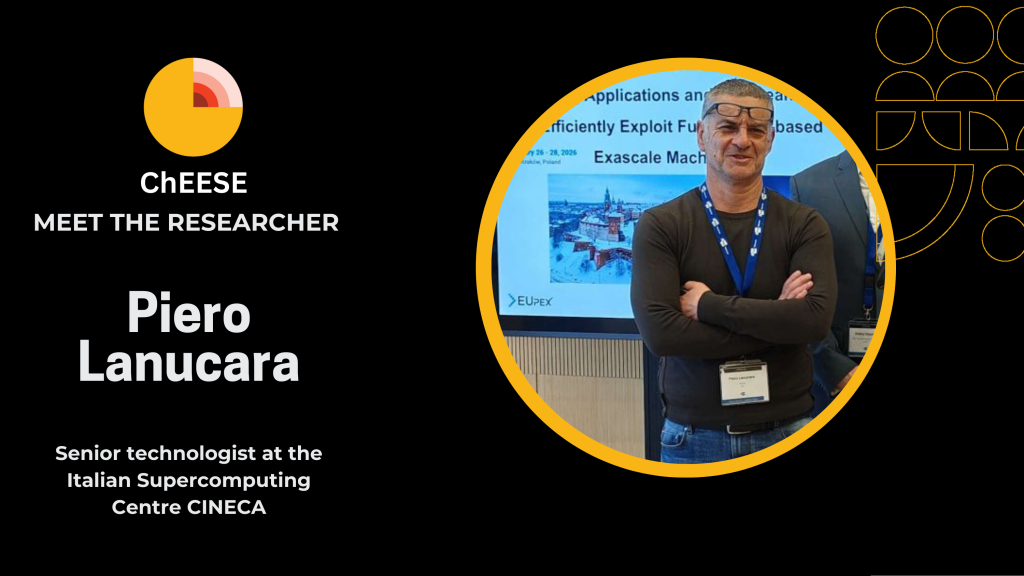
In this Meet the Researcher interview, Piero Lanucara reflects on his role at CINECA, the management of WP2 in ChEESE, and the invisible HPC infrastructure behind hazard assessment in Europe.
Piero Lanucara, senior technologist at the Italian Supercomputing Centre CINECA, is an applied mathematician by education and is currently involved in High-Performance Computing (HPC) activities within the High Level Support Team. He takes part in initiatives and projects in the Solid Earth area, including ChEESE, DT-GEO, and Geo-INQUIRE. His main interests involve the development, optimization, and porting of the ChEESE flagship codes to the EuroHPC hybrid CPU+GPU architectures.
In this interview for the Meet the Researcher series of the ChEESE Project, Piero shares his experiences, the challenges of high-performance computing in geoscience, and the crucial role of HPC in advancing our understanding of natural hazards.
What are the main contributions of CINECA to the ChEESE project?
CINECA has been involved in ChEESE activities from the very beginning, and of course, our contribution lies in the field of High-Performance Computing, which is a key element of the current project, just as it was in the previous one. From a strictly personal point of view, managing WP2 is a demanding task for me, but I try to give it a direction that is truly useful to the community of researchers in ChEESE. Therefore, in addition to the support activities for the codes and workflows of ChEESE, I definitely include this management effort as well.
Reflecting on the past year, what moment in your research or the project has been particularly significant for you, and why?
These kinds of projects have exceptional visibility and relevance, so I could say that every moment has been meaningful – from writing the proposal to any General Assembly meeting, I consider each step important. If I have to choose one, it would be seeing how many and what kind of scientific and technological contributions have been included in any of the WP2 deliverables. Those were definitely rewarding moments when I truly realized that my work could be of some use to the geoscience research community.
Can you explain how your work plays a role in hazard assessment?
To make a rather simple comparison, my work mostly supports research, so it doesn’t end up on the front page, so to speak! Nevertheless, I believe that the HPC component is crucial for running computationally demanding simulations, scenario and uncertainty analyses, decision support, and early warning systems. All these are critical elements in ChEESE, and that’s where my work becomes very valuable.
Are there any particularly challenging aspects or obstacles that you’ve encountered in your research in ChEESE, and how have you overcome them?
In ChEESE, we might have gone a bit overboard – we have as many as 11 flagship codes in the project, each with its own peculiarities and characteristics in moving toward Exascale (which is essential for this type of research). Managing all of this is quite challenging. In WP2, which is the work package where all of this takes shape, we’ve tried to maintain an appropriate profile and a pragmatic approach to the activities. We like to think – and hope -that we hit the mark. Time will tell!
Can you discuss any recent achievements or milestones that your team has reached within the framework of the project?
The CINECA team is very focused on supporting the activities related to each flagship code. That is our goal and achievement. Certain aspects, such as performance portability and the use of mini-apps to handle specific code-related tasks, have been and remain very important. We strongly believe in this working methodology and would like to extend it beyond the project’s context.
How do you foresee the impact of your research on the understanding and management of geological hazards in Europe?
Projects like ChEESE are part of high-level initiatives called Centers of Excellence (CoEs). ChEESE can certainly be considered a main pillar in the field of geological hazards. In Europe, we witness events every day that could be tackled with much better and more advanced skills and technologies – tools that are useful and necessary to save lives or, at the very least, to help local economies face these terrible natural phenomena in the best way possible.
What inspired you to become an HPC consultant, and what aspects of your work do you find most exciting?
My academic background is in applied mathematics. I’ve always been fascinated by viewing reality through a “mathematical” lens. Everything is mathematics (one might say, without it sounding meaningless). I’ve moved away from applied mathematics per se, but I’ve tried to maintain a methodical approach to HPC-structured, rigorous, and open to learning. What I find most fascinating is this vision of Nature as a Virtual Laboratory (thanks to HPC), where we can study an earthquake, a tsunami, or a Vesuvian eruption – without any of these catastrophic events actually happening. I find that idea particularly exciting.
If you were not a researcher, what career path might you have pursued?
Honestly, I have always appreciated the rigor and a certain level of abstraction in mathematics. In particular, the branch of applied mathematics has always fascinated me, and I would have liked to work in that field as a researcher. Moreover, I really enjoy finding links or connections between seemingly distant subjects. These “tunnels of thought” allow us to open unknown opportunities in areas where progress is slower or more difficult. So, I would have liked a job that allowed me to explore one or more of these tunnels of thought!
For aspiring individuals interested in a career in HPC, what advice would you offer to guide and inspire them?
I think this is an exciting time to engage in HPC, especially with the advent of Artificial Intelligence in our lives and soon in our daily routines. For a young person with a career ahead, incredible opportunities are opening up. My advice is to dedicate yourself fully – body and mind – to your work, keep your mind active and open, and look for those “tunnels of thought” that allow us to progress as researchers and as people. Also, teamwork is fundamental. ChEESE is a shining example of that. Every WP, including WP2, is the result of group effort and shared expertise. ChEESE wouldn’t exist without the teamwork that drives the resolution of its many scientific challenges. Individually, we may be useful, but as a team, we are truly powerful – it’s a bit like the principle of parallel computing, which is one of the cornerstones of HPC.
Outside of your scientific work, is there a cultural piece (such as a film, book, or podcast) that has had a significant influence on your perspective or approach to your research?
There are several, but I’ll mention two examples that are particularly close to my heart.
Book: The Hitchhiker’s Guide to the Galaxy by Douglas Adams is, in some ways, quite far from the topic. Nevertheless, it tells the story of this terrifying supercomputer that, after millions of years of calculations, comes up with the answer to the Ultimate Question: 42! At that point, this super-evolved race had to build an even bigger and more powerful computer to find out what the Ultimate Question was. In the end, research follows a similar path – and the ChEESE saga is no exception!
Music: I’m a big fan of Pink Floyd and find their most famous concept albums (Animals, The Wall, to cite some) fascinating. I believe that, in the end, ChEESE is a sort of concept album of Nature. I like the idea that different pieces of the same story eventually come together like in a great puzzle!
Published on February 09 2026.
By Aerton Guimarães
ChEESE-2P Dissemination Team