Rocks may look solid and still from the surface, but deep inside the Earth they are constantly on the move. Over millions of years, they flow, stretch, collide and sometimes break, shaping mountain belts, ocean basins and the geological structures beneath our feet.
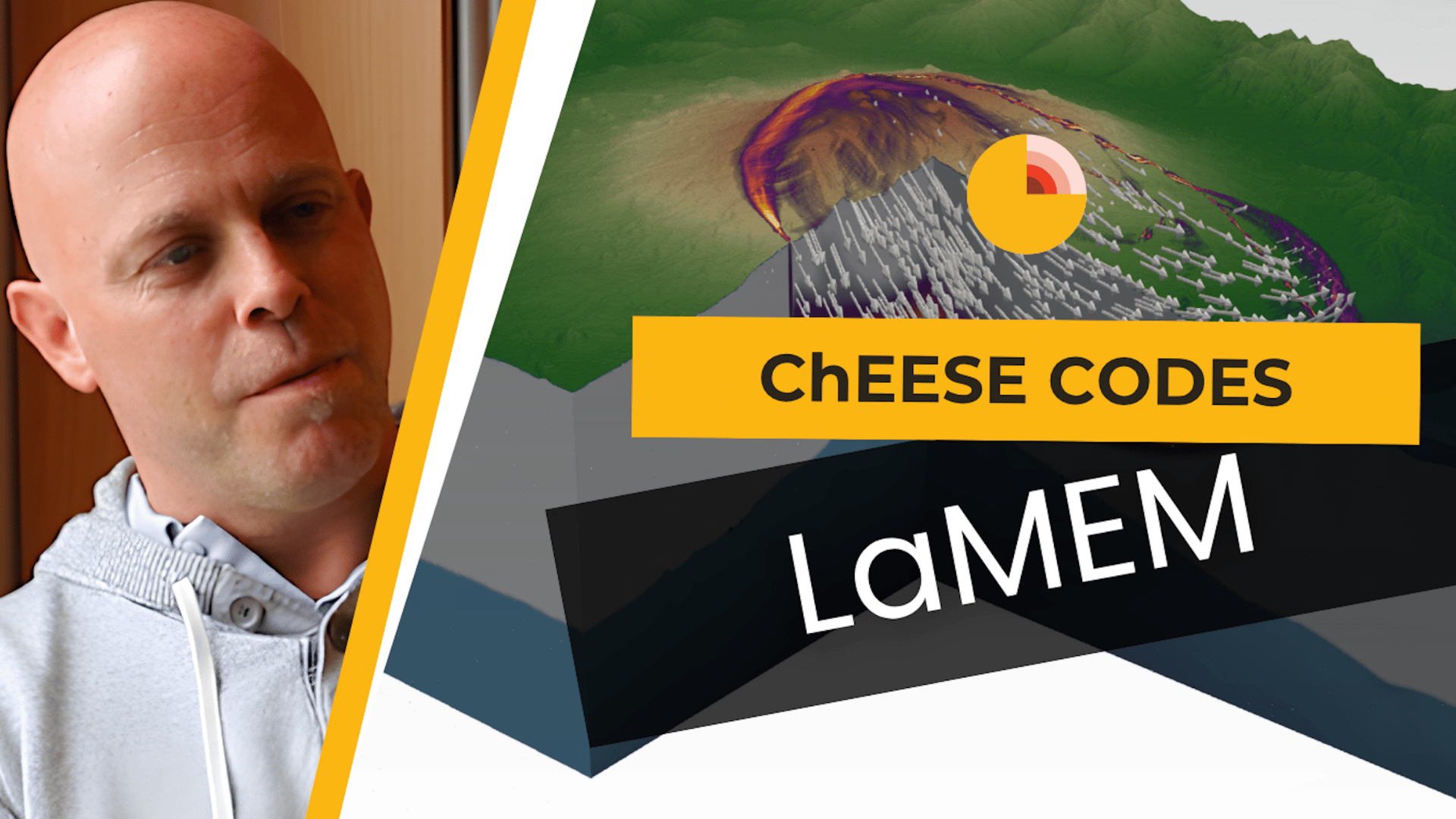
With LaMEM, a high-performance simulation code developed within Centre of Excellence (CoE) for Exascale in Solid Earth – ChEESE, researchers can recreate these slow but powerful processes in three dimensions. In this interview, Boris Kaus, Professor at the University of Mainz and LaMEM lead in ChEESE, explains how the code helps scientists explore the Earth’s past, test possible futures and tackle applied geoscience questions.
“On long timescales, rocks and the Earth deform like a fluid, like a viscous fluid, like honey,” Kaus explains. “But on shorter timescales, they behave elastically. Or sometimes they break and rupture and make a fault.”
This changing behaviour makes the Earth a particularly complex system to model. LaMEM is designed to simulate these processes across a remarkable range of spatial and temporal scales.
Making advanced modelling more accessible
High-performance codes can be powerful, but they also need to be usable. The LaMEM team has worked to make the software easier to install and run, including through a interface that supports model setup, execution and visualisation of results.
“LaMEM is certainly, at the moment, one of the easiest software packages to install,” says Kaus. “You can just open your laptop, you say ‘add LaMEM’, and it will install everything and work in a few minutes on your machine.”
This accessibility has helped build a growing user community, particularly among university research groups studying geological processes at different scales.
Understanding mount Etna
Within ChEESE, LaMEM will be used to investigate the southeastern flank of mount Etna, which is moving gradually towards the Mediterranean sea by a few centimetres each year.
The movement does not indicate an immediate collapse risk, but it raises important scientific questions. Understanding why the flank is moving and which factors influence its behaviour can contribute to the bigger picture of volcanic dynamics.
“It would be good to better understand how it is happening and why this is happening,” Kaus says.
By bringing complex geological processes to Europe’s supercomputers, LaMEM helps researchers follow the Earth’s slowest transformations. Processes that may be imperceptible in a human lifetime but profoundly shape the planet over geological time.
Watch the full interview with Boris Kraus:
Credits
- Published
- 26 August 2026
- Author
- Aerton Guimarães & Varvara Vedia — ChEESE-2P Dissemination Team